

Discover why AI deployment in Vietnam can outpace Europe. Learn how regulatory sequencing, governance, and enterprise execution accelerate AI pilots safely.
Introduction: Faster AI Deployment in Vietnam
Vietnamese enterprises often deploy AI pilots in 4–8 weeks, compared to Europe’s typical 6–12 months for similar low- to medium-risk internal use cases. This is not a reflection of weaker governance or superior technology. Rather, it reflects differences in how risk, learning, and approvals are sequenced within organizations.
This insight comes from Trung Huynh, former Google Research engineer and current Head of AI at XNOR Group. Drawing on his experience with Vietnamese businesses, Trung observes that early experimentation and pilot cycles can move faster in Vietnam, particularly in contexts where human-in-the-loop review ensures responsible AI usage.
Instead of debating which region is “better,” this article asks a more practical question:
“Why do AI adoption speeds differ, and how can organizations move fast without creating unnecessary risk?”

Vietnam AI Deployment: Where Time Actually Gets Spent
| Phase | What it includes | Typical Vietnam timeline | Typical European timeline | Why the gap exists |
| Pilot | Small-scope test, prompt/workflow design, basic evaluation | 2 – 6 weeks | 4 -12+ weeks | Europe requires more pre-checks (privacy, legal, vendor review) and formal pilot gates |
| Decision | Approve budget, security sign-off, greenlight rollout plan | 3 – 14 days | 2 – 8+ weeks | Multi-layer approvals and procurement cadence in Europe |
| Scale | Training, SOPs, monitoring, integration, governance | 2 – 6 months | 6 – 18+ months | Enterprise-wide compliance, documentation, auditability, and model risk management |
Note: The timelines below are experience-based estimates derived from practitioner observation, not official benchmarks. Actual timelines vary significantly by enterprise size, industry, regulatory exposure, and AI risk classification.
Why AI Deploys Faster in Vietnam: Regulatory Sequencing vs Compliance-First Models
The EU AI Act became fully enforceable on August 1, 2024, with high-risk AI system rules taking effect progressively through August 2027. This creates a compliance-first operating model where enterprises conduct extensive pre-deployment risk classification to ensure regulatory alignment.
Vietnam operates differently. Vietnam ranked 59th globally and 5th among ASEAN countries in the 2024 Government AI Readiness Index, with its National Strategy targeting the top 4 ASEAN status by 2030. Rather than prescriptive regulations, Vietnam’s government provides strategic signals that enable faster internal approvals.
| Regulatory Aspect | Vietnam Approach | Europe Approach | Business Impact |
| Philosophy | Strategy-led signaling | Compliance-led framework | Vietnam: Faster psychological permission; Europe: Stronger legal clarity |
| Pre-deployment requirements | Narrow scope + post-pilot governance | Pre-pilot risk classification + documentation | Different sequencing of when controls happen |
| Approval levels | Often VP-level (3-14 days) | Multi-stakeholder (2–8+ weeks) | Shorter decision chains in Vietnam |
| Risk management timing | Learn-then-govern | Comprehensive risk Govern-then-learn | Vietnam prioritizes early learning velocity; Europe prioritizes accountability |
Both approaches are valid; they simply optimize different organizational priorities. Vietnam emphasizes learning velocity, and Europe emphasizes early accountability and transparency.
Vietnam’s National AI Strategy (2021) and the anticipated first dedicated AI law (effective 2026) signal AI as a national priority, not just experimental technology. Historically, these signals have boosted enterprise confidence in approving pilots, though formal compliance will gradually moderate speed advantages.
This signaling historically increased enterprise confidence in approving pilots, though this effect is expected to moderate as formal compliance requirements come into force.
Observable ecosystem effects (2021-2024):
- Investment capital for AI startups in Vietnam grew strongly during 2022–2024.
- AI startups grew from 60 in 2021 to 278 in 2024, a 4.5x increase
- Enterprise pilot approval cycles compressed from 6-12 weeks to 1-2 weeks
Europe shows parallel momentum despite longer timelines. The AI Innovation Package allocated about €4 billion for 2024-2027 to support generative AI development, while AI Factories across 17 EU member states received combined investments of around €485 million to provide privileged access for startups and SMEs.
The critical difference: Government support cannot substitute for internal execution fundamentals. Data quality, technical capability, and clear ownership determine success regardless of the external environment.
AI Deployment in Vietnam’s Media Sector
Media organizations face unique adoption pressure:
- Short content cycles: Faster production required
- High volume: Constant content generation
- Thin margins: Minimal tolerance for inefficiency
Platforms like Marcom-AI and tools developed with Actable AI demonstrate that AI can act as an editorial assistant, reducing repetitive work while keeping human review mandatory.
Note: These dynamics are not generalizable to high-risk sectors like finance, healthcare, or fully automated decision-making.
Vietnam’s AI Deployment: A Co-Creation Model
Vietnam’s AI ecosystem operates on a distinct partnership model rather than traditional vendor-client handoffs. Many collaborations follow this sequence:
- Prove: Test value on specific workflow with narrow scope
- Refine: Improve the solution in production-like conditions
- Partner: Discuss long-term partnership only after validation
This reduces risk for both parties. Enterprises avoid committing to unproven systems. Vendors gain real-world feedback early.
Despite favorable conditions, pilot failure rates remain significant. The most common blockers, unclear ROI, fragmented data, and unclear ownership, are consistent with global enterprise AI post-mortems.
90-Day Deployment Framework: Speed with Guardrails
Moving fast doesn’t require large programs or perfect systems. It requires disciplined sequencing: start narrowing, learn early, and standardize what works.
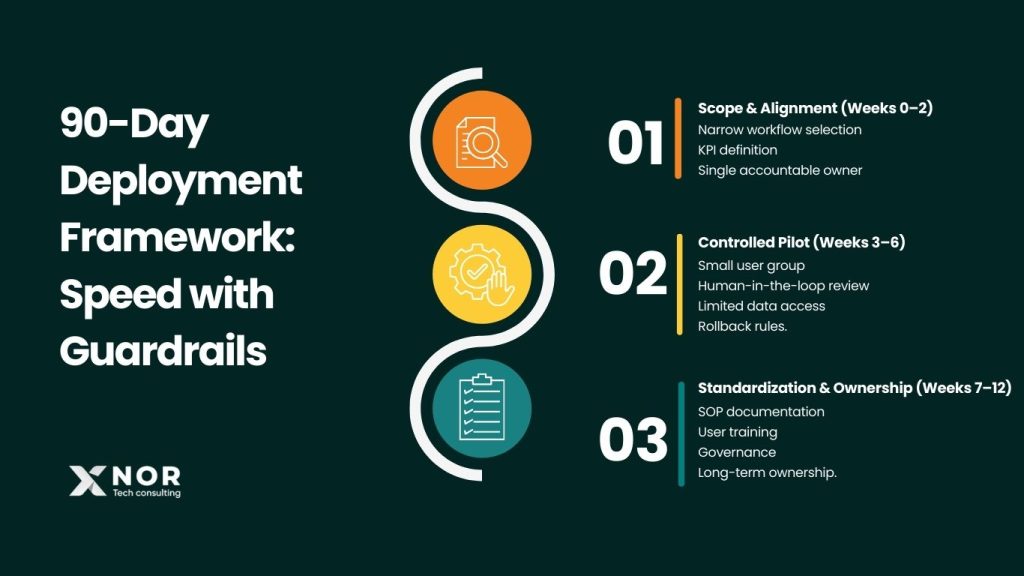
Phase 1: Scope & Alignment (Weeks 0-2)
Select one narrow workflow (internal search, draft generation, data extraction). Avoid changing core business logic in initial pilots. Define one baseline KPI (time saved, error rate, turnaround time). Assign a single accountable owner with decision-making authority.
Expected outcome: Shared definition of success before any technical work begins.
Phase 2: Controlled Pilot (Weeks 3-6)
Deploy to a small user group (5-20 people maximum). Apply explicit guardrails: limited data access (only necessary information), human review checkpoints (output validation required), and clear rollback rules (how to revert if problems arise). Prioritize learning over optimization.
Expected outcome: Operational feedback from real users with controlled risk exposure
Phase 3: Standardization & Ownership (Weeks 7-12)
Document standard operating procedures. Train users and operators on consistent usage patterns. Decide vendor/model strategy (internal development, external API, hybrid). Establish long-term ownership and maintenance of responsibility.
Expected outcome: Repeatable process ready for broader deployment
Each phase builds on previous learning without requiring a large upfront investment. Problems surface early when they’re cheap to fix. Success criteria remain clear throughout.
Conclusion: Vietnam’s AI Advantage Is Conditional
Speed alone is not an advantage. Vietnam’s operating context has enabled faster early experimentation in certain scenarios, but this advantage is conditional and expected to narrow as Vietnam’s AI law comes into effect from 2026, increasing compliance and governance requirements.
Vietnam should be viewed as a context for early applied learning, not a shortcut around ethics, labor impact, or accountability.
The organizations that benefit most are not those that move fastest in absolute terms, but those that treat pilots as the beginning of a capability. By pairing early momentum with structure, ownership, and governance, short-term speed can be converted into durable organizational competence rather than isolated experiments.