Enterprise AI Agents

Build the AI-enabled enterprise.

We help businesses become AI-enabled: securely, measurably and at scale. It starts with agents that answer from your own internal data and act with human approval: permissioned down to role, audit-ready, and built to pass a security review before they answer a single question.

CFO Agent
What was our revenue last month?

June revenue closed 8% above plan, with gross margin holding at 41%. Collections improved: overdue receivables are down to two accounts.
Tier: Exec ✓Source: Monthly-Report-2026-06

Was this answer helpful?

👍👎
What about current AR?
All invoices have been paid except one: Acme Ltd, invoice INV-2214, now 15 days overdue. The client-level aging detail is in the weekly receivables report.
Tier: Exec ✓Source: Receivables-Weekly-W31

Was this answer helpful?

👍👎
/ar-remind Acme Ltd
Draft ready. Review the card and approve to send from the finance mailbox. Nothing goes out without your click.
Approval card · Exec onlyAudit logged

AR reminder draft · Acme Ltd

InvoiceINV-2214
Overdue15 days
Send fromFinance shared mailbox
Reminder levelFinal notice
Send emailRequest changesCancel
Reminder sent to Acme Ltd from the finance shared mailbox, with the invoice and the final-notice wording you approved.
Sent once · idempotentAudit logged

Was this answer helpful?

👍👎

“The hard part is not the pilot.
It is production you can trust.”

Ethan Pham · CEO, XNOR Group

Most enterprise AI stalls between a promising demo and a system leadership will stand behind, because a chat window is not an agent. An enterprise AI agent is an AI assistant that works inside your own systems: it answers from your internal documents at each person’s permission level, acts only with human approval, and leaves an audit record for every step. That is exactly what XNOR builds: permissions resolved in code you can audit, fail-closed controls, and a verdict from every reader on every answer. What the model is never shown, it cannot reveal. What your people rate, you can improve.

The AI agents

Three specialists, one proven core.

Each agent pairs one business function with the same security architecture. The pattern extends to Operations, Sales, Delivery, Legal and Compliance, or any function that runs on documents.

Two things every agent does

01

Answer

A sourced answer to a question, rendered at the asker’s access level, citing the document behind every figure. Read-only, and the default mode for everyone.

02

Act

Run the steps of a process you have already documented, partly or end to end, on request or on a schedule. Restricted to the executive and manager roles.

CFO Agent

Finance assistant for the leadership team

Sourced answers on revenue, receivables, budgets and finance procedures, plus the recurring finance workflows around them.

  • Cites the exact report or SOP behind every number
  • Three permission tiers bound to corporate identity
  • Runs collection reminders, report distribution and deadline chasing, each approved before it goes out
Explore the CFO Agent

HRM Agent

HR assistant for the employee lifecycle

Policy answers scoped to each person’s authority, and the lifecycle processes behind them automated end to end.

  • Individual pay and personnel files hard-blocked at every tier
  • Onboarding and offboarding driven from your own process, one command each
  • Recurring HR reporting and deadline tracking, without anyone remembering to run it
Explore the HRM Agent

Knowledge Agent

Company knowledge for every employee

Strategy, policies, OKRs and guides for the whole company, answered only from documents leadership has approved.

  • Publishing and retirement pipeline with a recorded approval per document
  • Unpublish takes effect on the very next question
  • Scheduled digests and publishing reminders to document owners
Explore the Knowledge Agent

Security first

4 independent layers of protection, every one of them fail-closed.

If any layer fails, the system refuses to answer rather than risk a leak.

01

Least privilege at the source

The agent’s credentials can only reach the libraries it is meant to read. Out-of-scope access is denied by the platform itself, verified with negative tests.

02

Documents filtered in code, before the model

A deterministic allowlist decides what enters the context, per tier, per request. What the model cannot see, it cannot reveal.

03

Prompt policy that resists manipulation

Retrieved documents are wrapped as untrusted data with structural markers neutralized, so a planted document cannot escape into system authority.

04

Every answer post-checked before it is sent

A deterministic screen plus an independent model verdict. Only an explicit pass ships. In doubt, it blocks.

Fail-closed

Permissions cannot be resolved? Refuse. Post-check unreadable? Block. Unknown chat type? Treated as the most public audience. Every default protects your data.

Read the full security model

Your ecosystem

Runs where your business already runs.

The channel, document and model layers are each isolated behind a single interface, so the platform adapts to your stack instead of replacing it.

Where your team chats

The agents live inside the conversation, not in another tab.

Microsoft TeamsSlackGoogle ChatZaloWeb widget

Where your documents live

Read in place, within permissions. No copy of your data is taken anywhere.

SharePoint / Microsoft 365Google DriveConfluenceNotionAmazon S3

Which model answers

Model per role is a configuration variable, never a code change.

Claude (Amazon Bedrock)DeepSeek (Amazon Bedrock)Other Bedrock modelsAzure OpenAI
Supported today Adapted per engagement

Architecture

The whole system, on one map.

Every question runs the same route: identity first, then a scoped search, then two more models before anything is allowed out. Pick a scenario and watch it travel the map.

Run a scenario

What was our revenue last month?

message verified draft pass identity in permissions layer 1 layer 2 evidence human approval Chat channel MS Teams, Slack... Bot registration endpoint only Agent orchestrator serverless, in your own cloud Guard model layer 3 Reply in chat with sources linked Company directory Document library Keyword model Main model Audit log Approval card
01

The question arrives in a 1:1 chat and is acknowledged in 0.4s.

Swipe the map sideways to follow the whole route.

Live in this run Blocked here Not reached

Value for your business

1 investment, 4 layers of value.

Faster decisions

Leaders and their teams get a sourced answer in about 30 seconds, 24/7, inside Teams. No new application to adopt, no waiting for a report to be compiled.

Near-zero running infrastructure cost

Serverless throughout, so there is no cluster sitting idle and nothing to patch. The only line that scales with use is model requests, and the admin console shows that spend per question, per person and per model with a month-end forecast. No servers to run, no dedicated ops team.

Safe by design

Staff get an official AI channel over internal data instead of pasting it into outside tools. Permissions, audit and compliance are designed in from the start.

A path to scale

A shared core architecture: the next department’s agent takes days, not a rebuild. Upgrading the model does not mean changing the system.

Operations included

Multiple agents. 1 control plane.

The part most AI agent projects skip, and the reason they die before they can prove their value.

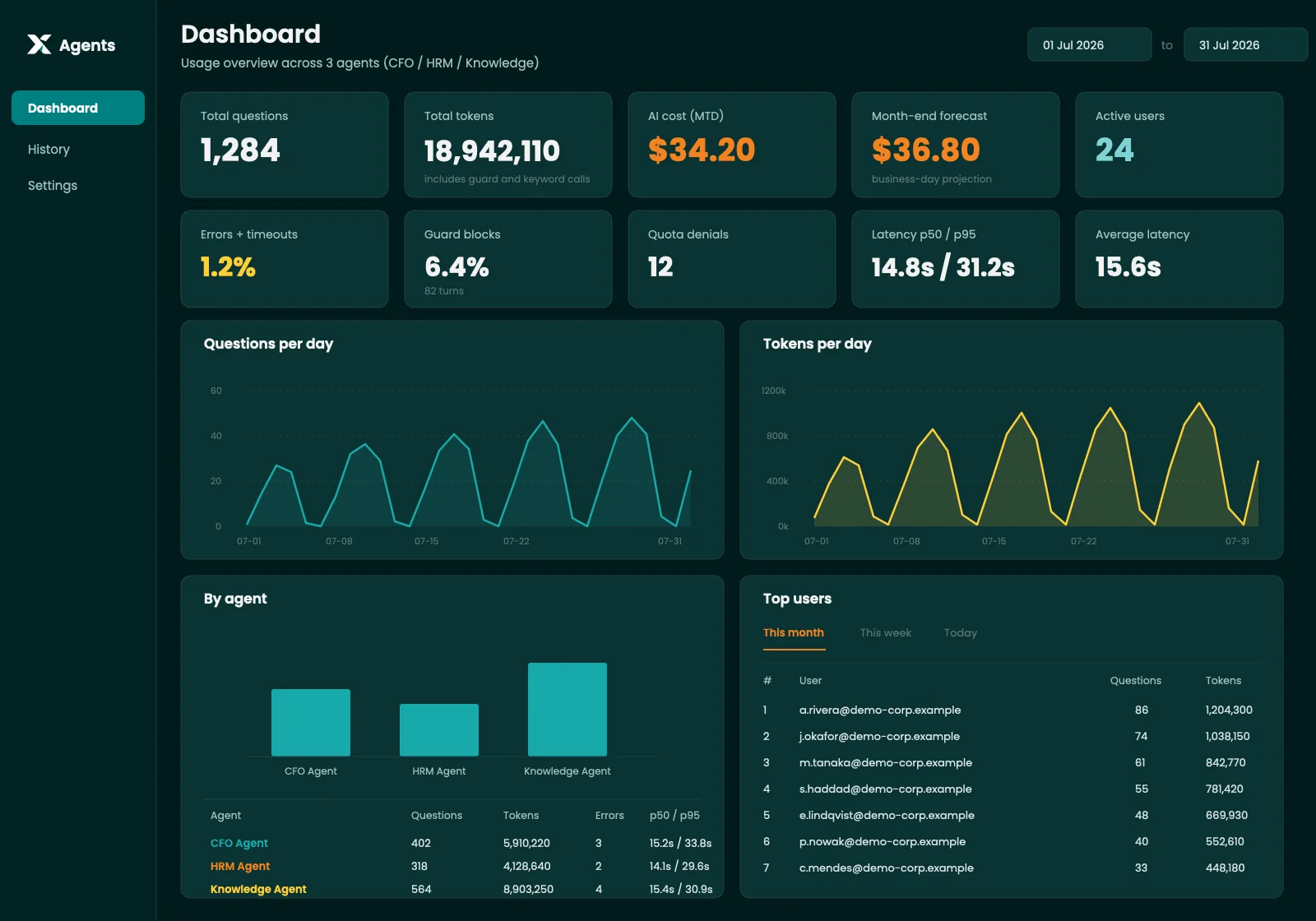
  • Cost you can seeAI spend per question, per user, per model, with a month-end forecast.
  • Quotas that protect the budgetDaily per-person limits with exceptions, so AI cost stops being an open number.
  • Permissions without ticketsAccess group changes take effect within 15 minutes, no IT queue.
  • Audit trail by defaultWho asked, the keywords extracted from the question, what was retrieved, what the guard decided and the status of the answer.
  • Answer quality, measuredA thumbs up or down under every answer, from the person who asked. Satisfaction and wrong-refusal rates per agent, shown right beside its cost.
XNOR Agents Admin dashboard showing usage, cost and per-agent metrics with demo data

The XNOR Agents Admin console, shown with demo data.

Working with us

From assessment to your first agent live, on a route we have already proven.

AI is designed into the engagement from day one, not bolted on afterward. The permission model, the audit trail and the security evaluation are part of the build, not a phase you add later.

Phase 1

AI readiness and strategy

2-3 weeks

  • Map your data sources, permissions and audiences
  • Pick the first agent with a measurable owner and use case
  • Security and compliance review with your team, run by our AI consulting practice
Phase 2

Your first agent, in production

4-6 weeks

  • Build on your own infrastructure, so data never leaves your systems
  • Adversarial security evaluation must pass before rollout
  • Pilot group, feedback loop, acceptance matrix
Phase 3

Scale, governance, handover

2-4 weeks per agent

  • Clone the proven core to the next function
  • Admin console, quotas and audit reviews in place
  • Handover, training and support model of your choice

Our clients

Trusted by clients we work with.

Common questions about enterprise AI agents

What is an enterprise AI agent?

An AI assistant that operates inside your company’s own systems instead of a public chat window. It answers questions from your internal documents at each person’s permission level, runs processes you have documented with human approval on every outbound step, and writes an audit row for everything it does.

How is this different from ChatGPT or Microsoft Copilot?

Three ways. The agents answer only from documents your company approved, so there is no general-web guessing. Permissions are resolved in code before any model call, so what someone must not see never reaches the model at all. And the whole stack runs serverless in your own cloud account, with an admin console for cost, quotas and audit.

Does our company data leave our systems?

No. The agents read documents in place from your own libraries, within permissions you grant, and take no copy of your data anywhere. In a typical engagement the entire stack, including the models via Amazon Bedrock, runs inside your own cloud accounts.

Which chat platforms and document stores are supported?

Microsoft Teams and SharePoint / Microsoft 365 are supported in production today. Slack, Google Chat, Zalo, Google Drive, Confluence and other stores are adapted per engagement: the channel and document layers sit behind single interfaces designed for exactly that swap.

How long until the first agent is live?

Typically 6 to 9 weeks end to end: 2 to 3 weeks for AI readiness and strategy, then 4 to 6 weeks to build the first agent on your infrastructure, pass the adversarial security evaluation and run the pilot group. Each following agent takes 2 to 4 weeks on the shared core.

Next step

See the agents actually working.

Book a 30-minute demo: we show you the agents running in production, and sketch out the first agent for your business with you.